In a groundbreaking development that could redefine the future of quantum communication, researchers have unveiled the world's first "photon entanglement farm" – a dedicated facility designed to mass-produce entangled photon pairs for large-scale quantum networks. This cutting-edge facility represents a paradigm shift from laboratory-scale experiments to industrialized quantum resource production, potentially accelerating the advent of practical quantum internet.
The concept of entanglement farming draws inspiration from both quantum physics and agricultural metaphors. Just as traditional farms cultivate crops, these specialized facilities "grow" entangled photon pairs in carefully controlled quantum environments. The photons produced here exhibit that spooky connection Einstein famously questioned – where measuring one instantly affects its partner, regardless of distance. What makes this farm revolutionary is its ability to generate these quantum correlations not in precious few pairs, but in the vast quantities needed for real-world applications.
At the heart of the entanglement farm lies an array of advanced nonlinear optical systems that convert laser light into entangled photon pairs through spontaneous parametric down-conversion. Unlike experimental setups in university labs that might produce thousands of pairs per second, the farm's industrial-scale apparatus can generate billions of entangled pairs simultaneously. The facility incorporates multiple redundant systems to ensure continuous operation, with quantum purity monitoring occurring at every production stage.
The technical challenges overcome to establish this facility were formidable. Maintaining quantum coherence across mass-produced entangled pairs required solving numerous engineering puzzles. Temperature fluctuations had to be stabilized to within thousandths of a degree, and vibration isolation systems more precise than those in semiconductor fabrication plants were developed. Perhaps most crucially, the team created novel quantum memory buffers that can temporarily store entangled photons without decoherence, allowing for synchronization between different quantum network nodes.
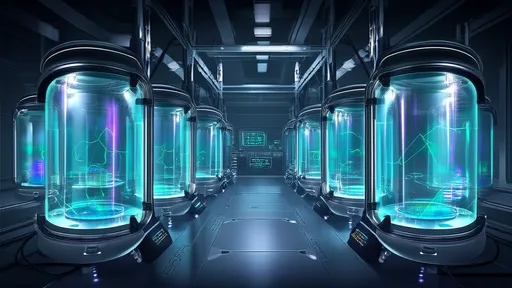
What sets this facility apart is its modular design philosophy. The farm isn't a single monolithic system, but rather a collection of specialized "quantum cultivation pods" that can be configured for different entanglement protocols. Some pods produce polarization-entangled photons ideal for quantum key distribution, while others generate time-bin entangled pairs better suited for fiber optic transmission. This flexibility ensures the farm can meet diverse requirements of emerging quantum network applications.
The implications for quantum communication infrastructure are profound. With a reliable source of high-quality entangled photons available at scale, researchers can now realistically plan metropolitan-scale quantum networks. Early test deployments have already demonstrated the ability to distribute entanglement across nodes separated by over 100 kilometers of optical fiber, with the farm simultaneously supplying multiple independent quantum channels. This multi-user capacity hints at a future where entanglement becomes a utility-like resource, allocated on demand to various applications.
Beyond communication, the entanglement farm opens new possibilities for distributed quantum computing. The facility's ability to produce "entanglement on tap" could enable cloud-based access to quantum resources, allowing distant quantum processors to interconnect through shared entanglement. Researchers speculate that future iterations might even produce complex multi-photon entangled states required for measurement-based quantum computation approaches.
The economic model behind the entanglement farm suggests an interesting evolution in quantum technology commercialization. Rather than selling individual quantum devices, the facility operates on a service model – providing entanglement as a quantifiable resource to network operators and research institutions. Early pricing models suggest costs could drop to mere cents per entangled pair once full production capacity is reached, dramatically lowering barriers to quantum technology adoption.
As with any emerging technology, significant challenges remain. Scaling distribution networks to handle the farm's output without excessive photon loss presents engineering hurdles. Questions about standardization of entanglement metrics and protocols need resolution as these quantum resources enter broader use. Nevertheless, the successful operation of this first entanglement farm marks a watershed moment – the transition of quantum entanglement from delicate laboratory phenomenon to engineered, industrial-scale resource.
The research team is already planning next-generation facilities that will incorporate quantum repeater technology directly into the production line, potentially enabling continental-scale entanglement distribution. Other groups worldwide have begun developing similar concepts, suggesting that entanglement farming may soon become a cornerstone technology in the burgeoning quantum economy. As these facilities proliferate, they may well become the power plants of the quantum internet era – generating not electricity, but the far more exotic fuel of entangled quantum correlations.

By /Jul 9, 2025
By /Jul 18, 2025
By /Jul 18, 2025
By /Jul 18, 2025
By /Jul 18, 2025
By /Jul 9, 2025

By /Jul 18, 2025

By /Jul 18, 2025

By /Jul 10, 2025
By /Jul 18, 2025

By /Jul 18, 2025

By /Jul 18, 2025
By /Jul 9, 2025

By /Jul 10, 2025
By /Jul 18, 2025

By /Jul 18, 2025

By /Jul 18, 2025
By /Jul 18, 2025

By /Jul 18, 2025

By /Jul 18, 2025